
Beyond Flowerpots: Anchoring Perennial Borders with Monumental Urns
Why Your Garden Border Needs an Architectural Anchor
Perennial borders are designed to change. Spring bulbs give way to summer flowers, grasses gather movement in autumn, and seed heads remain when much of the garden has gone quiet. That seasonal variety is part of their charm, but it can also leave a border visually unsettled, particularly when every plant is competing for attention. A pot used only as a temporary container often disappears into this cycle, useful for a season but unable to provide lasting structure.
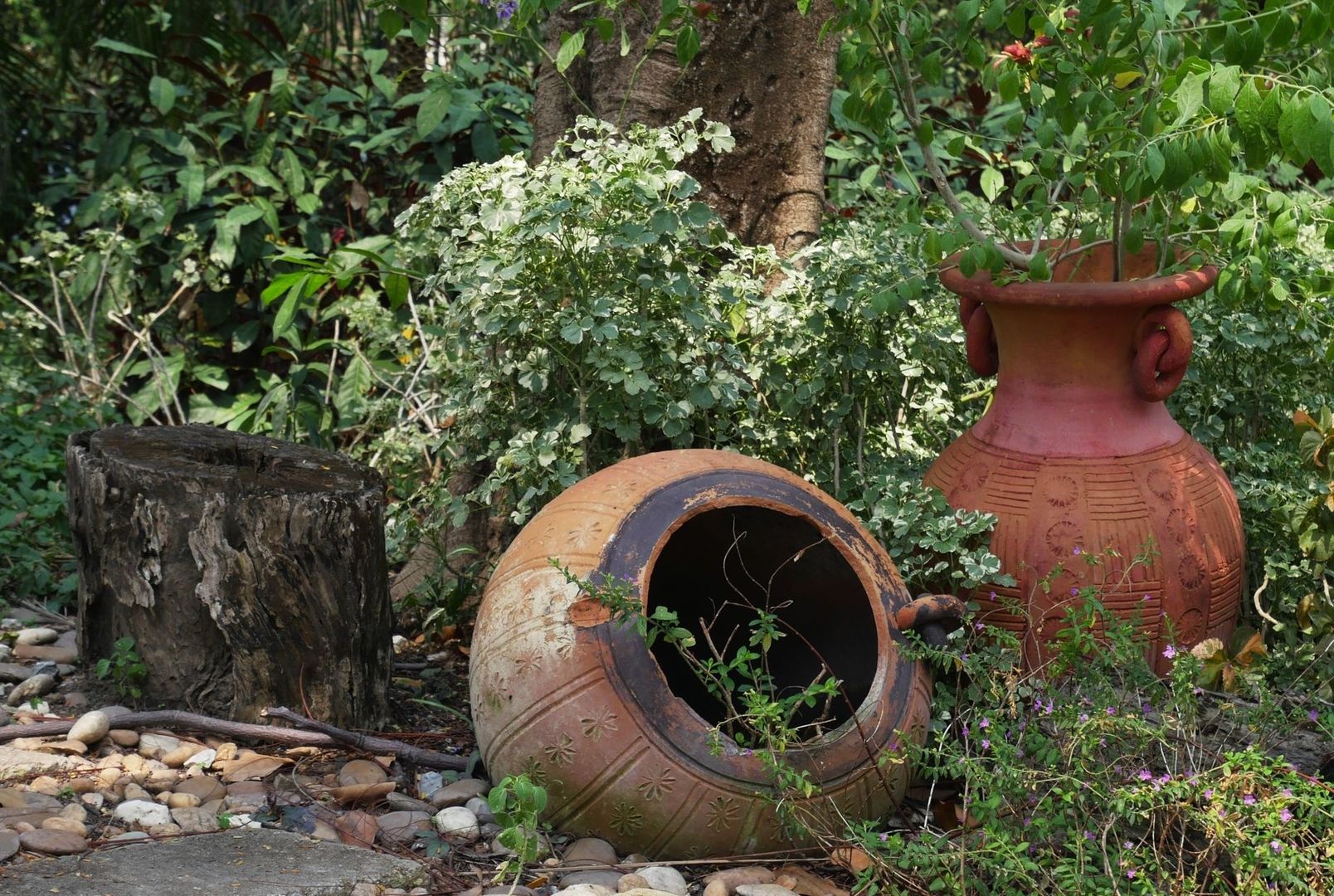
A monumental urn offers a more enduring solution. Its silhouette remains when flowers fade, its mass counters the looseness of perennial drifts, and its position can establish a clear visual destination. Whether placed at the end of a path, beside a gate, or within a generous planting bed, a substantial vessel creates four-season presence. It gives the eye a place to rest, establishes hierarchy among foliage and flowers, and introduces the kind of spatial rhythm usually associated with formal gardens, courtyards, and historic estates.
Mastering Scale and Visual Dominance Among Perennials
The first decision is not the urn”s color or planting scheme, but its visual authority. A monumental vessel should be large enough to hold its position among mature plants without becoming a decorative afterthought. This does not mean choosing the biggest possible piece. Scale is relative to the border, the architecture, and the viewing distance. A tall urn may dominate a compact courtyard, while a broad, heavy vessel may be exactly what is needed to steady a long border filled with ornamental grasses.
Good composition depends on hierarchy. If every plant and object is equally bold, the eye has no clear entry point. The urn can serve as the dominant form, with flowering perennials and foliage acting as sub-dominant accents while lower groundcovers recede around its base. Coarse foliage, vivid warm colors, and dense plant masses carry considerable visual weight, so they should be balanced rather than clustered indiscriminately around the vessel. Fine grasses, ferns, and airy flowering stems can soften the transition without competing with the urn”s outline.
Placement determines whether the vessel frames a view or terminates one. Along a path, position it where the eye naturally travels, perhaps beyond a low planting layer or at the end of a gentle axis. In a deep border, allow the urn to remain partly visible through see-through plants instead of burying it behind a wall of foliage. The mature size of neighboring plants matters as much as their appearance at installation. A border inspired by the layered, ecologically rich plantings described in North Carolina native garden design demonstrates how repeated stones, containers, paths, and varied plant communities can give a large planting visual order.
- Use one clearly dominant urn where the border already contains abundant plant variety.
- Repeat smaller related forms only when they help lead the eye through a path or long garden room.
- Leave enough negative space around the vessel for its silhouette to remain legible in winter.
- Balance a large urn with an equivalent mass elsewhere, such as a shrub, hedge section, or substantial grass clump.
Glazed Sheens Versus Weathered Matte Terracotta
Finish changes the way an urn behaves in the landscape. A glossy glaze catches sunlight, reflects nearby foliage, and can make a vessel appear more animated as the day progresses. Blue, green, charcoal, and deep ochre glazes are especially effective beside fine-textured plants such as ferns, ornamental grasses, and delicate seed heads. Their reflective surface creates contrast with leaves, while a dark glaze can sharpen pale flowers and silver foliage.
Matte terracotta has a quieter authority. Its warm, porous appearance sits naturally beside broad leaves, bark, stone, and dry grasses, making it particularly suitable for informal perennial borders and traditionally styled gardens. Rather than reflecting the surroundings, raw clay absorbs light and visually settles into the soil. That grounded quality helps a large urn feel established, even when the planting around it is loose, abundant, or slightly wild. The long history of fired earthenware, explained in this authoritative terra cotta reference, helps explain why the material remains closely associated with classical garden design.
Neither finish is universally superior. Glazed pottery often requires careful inspection for frost resistance, and its surface may show water marks or mineral deposits. Matte terracotta can weather beautifully but may absorb moisture and suffer in severe freeze-thaw conditions if the vessel is not designed for outdoor exposure. Select the finish according to the garden”s mood, the surrounding materials, and the amount of seasonal care available.
| Design consideration | Glazed finish | Weathered matte terracotta |
|---|---|---|
| Light response | Reflects sunlight and nearby foliage | Absorbs light with a soft, quiet appearance |
| Overall mood | Polished, expressive, and sometimes formal | Grounded, historic, and naturally settled |
| Plant pairings | Ferns, grasses, silver foliage, pale flowers | Broad leaves, shrubs, bark, warm-toned perennials |
| Maintenance concern | Check glaze integrity and frost rating | Monitor moisture absorption and freeze damage |
Cultivating Character with Organic Patina Washes
New pottery can look too crisp beside an established border. Its clean surface may contrast sharply with weathered stone, mature bark, and soil that has developed its own subtle variations. Natural aging eventually softens that difference. Moss, lichens, mineral deposits, algae, and repeated wet-dry cycles gradually create a surface with tonal depth, but the process can take years and will vary according to shade, humidity, airflow, and water quality.
A gentle patina wash can accelerate the impression of age without disguising the urn”s form. The aim is not to cover the surface evenly, but to create irregular areas of softness around the rim, lower body, and shaded side. A mixture containing live moss slurry, diluted buttermilk, and a small amount of liquid kelp can encourage a biological film in suitable damp conditions. Results are not guaranteed, and natural growth should never be encouraged on a vessel where it could damage a fragile finish or obstruct drainage.
- Clean loose dust from the urn with a soft brush and allow the surface to dry. Avoid harsh chemicals that could harm nearby soil organisms or leave residues.
- Blend a small amount of live moss with diluted buttermilk and a few drops of liquid kelp. The mixture should be brushable rather than thick enough to form a sealed coating.
- Apply the wash unevenly to the rim, recesses, lower third, and naturally shaded side. Leave broad areas of the original finish visible so the vessel does not look artificially painted.
- Place the urn in a consistently damp, shaded or partially shaded position, then inspect it periodically. Keep the drainage opening clear and remove growth that becomes excessive.
Patience is important. A biological patina develops according to local conditions, not a fixed timetable. In dry climates, a subtle mineral wash or carefully applied exterior color may be more reliable than moss. Any decorative treatment should remain outside the planting cavity unless the product is explicitly safe for contact with soil and roots.
Foundations and Drainage for Heavy Garden Vessels
A monumental urn needs a foundation, not simply a shallow depression in the planting bed. Begin by excavating the footprint to remove soft topsoil and organic material that can settle unevenly. Fill the excavation with compacted crushed gravel in layers, checking the surface with a level as work progresses. In some settings, a properly laid paver base provides a cleaner finished edge and distributes weight effectively. The goal is a firm, level platform that resists movement during wet weather and frost heave.
Drainage is equally important. Water trapped beneath a heavy vessel can soften the soil, encourage subsidence, and create a damp zone that affects surrounding roots. A gravel base should shed water into the surrounding soil rather than form a sealed basin. Where natural drainage is poor, consider a deeper drainage layer, a perforated drainage route, or a slight fall directing water away from the foundation. The vessel itself should have an open drainage hole, and it should never sit flat against an impermeable surface that prevents water from escaping.
Planting around masonry or gravel foundations requires attention to local conditions. Plants selected for wet winters may still fail if their crowns remain saturated beside the urn. Guidance in Gardening with Oregon native plants emphasizes matching species to soil, moisture, light, drainage, and microclimate rather than assuming that even well-adapted plants are maintenance-free. Use smaller perennials near the base, allow roots to establish gradually, and keep vigorous spreaders from pressing directly against the vessel.
- Excavate beyond the urn”s exact footprint so the base remains stable and easy to level.
- Compact crushed gravel in successive layers rather than relying on loose fill.
- Keep the vessel”s drainage opening clear with a raised support or porous spacer.
- Allow a modest planting gap around the base for inspection, airflow, and future maintenance.
- Check the level again after the first wet season and correct settlement promptly.
Winterizing Monumental Pottery for Year-Round Architecture
Freeze-thaw damage begins when water enters the soil or porous ceramic, freezes, expands, and creates internal pressure. The risk increases when drainage holes are blocked or when a narrow opening allows an ice seal to form. Before winter, remove excess water from the planting cavity, clear debris from the drainage opening, and confirm that the vessel is rated for outdoor freezing conditions. Thick-walled, frost-resistant pottery with a tapered or generously open form generally handles expansion more safely than thin, narrow vessels, but no ceramic is completely immune to severe weather.
Discrete pot feet, stone risers, or corrosion-resistant wedges can lift the urn slightly above its base while preserving its architectural appearance. For an empty vessel, a flexible perforated insert placed above a layer of drainage material can provide additional room for expanding ice, provided it does not obstruct drainage. If the urn contains plants, choose hardy specimens suited to the local climate and protect the planting separately. Empty winter vessels can remain visually strong when filled with architectural seed heads, evergreen branches, twisted stems, or pruned ornamental grass plumes. These materials provide height and movement without requiring a seasonal replanting scheme.
- Keep all drainage routes open before freezing weather arrives.
- Use discreet risers to prevent the vessel from sitting in standing water.
- Avoid sealing a narrow opening with wet soil or dense planting material.
- Inspect for cracks after major freeze-thaw events and repair or relocate damaged pottery promptly.
Transform Your Garden Landscape with Lasting Architectural Presence
A monumental urn changes the role of pottery in a perennial border. Instead of functioning as a disposable seasonal container, it becomes part of the garden”s permanent framework, alongside paths, walls, hedges, trees, and paving. Its success depends on proportion, placement, finish, foundation, and drainage, but the reward is substantial: a stable focal point that remains legible through flowering, dormancy, rain, and snow.
The strongest compositions allow the urn”s classical solidity to meet the garden”s natural movement. Grasses bend around it, seed heads catch against its rim, and broad leaves reveal the strength of its silhouette. With careful installation and winter protection, the vessel can become more convincing with every passing year, gathering the marks of climate and use while giving the border a calm, enduring center.